
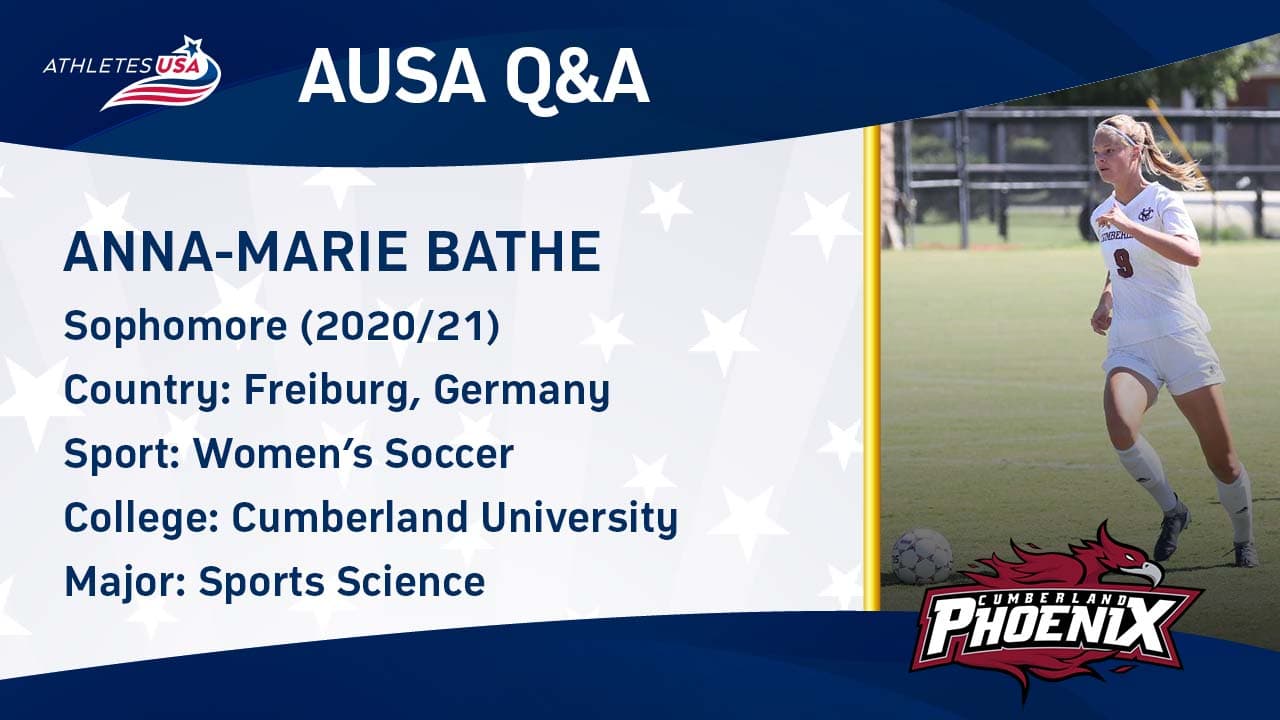
Marie Bathe grew up in Kirchzarten near Freiburg and played for SC Freiburg and TSV Alemannia Freiburg-Zaehringen. After finishing her Abitur in 2019, she moved 4,000 miles to Lebanon, Tennessee - half an hour from Nashville - to study sports science and play women's college soccer at Cumberland University on an athletic scholarship.
Her first season could hardly have gone better: twice voted into the team of the week, named to the team of the season, and honored as Freshman of the Year.
What the system actually feels like
How can we imagine the university system in America?
“My degree is fully accredited in Germany, which means that I had no risk by taking this huge step. … The fellow students are real fans, there are mascots and cheerleaders. This makes everyday life at university more exciting and unites the whole university.”
The teaching itself runs close to the German model, she says, with more personal support and a far larger role for sport - though the academic results are not allowed to suffer for it.
Can you describe a typical day as a sports student?
“It all depends on the season. … In the season, training is required every day. It's hard, but you get better day by day, it's really fun!”
Lectures run from eight in the morning into the afternoon, then training starts - usually two hours at high intensity. Games fall on Wednesday and Saturday, sometimes with a hotel the night before and a team bus she calls quite professional. Because the training is that intense, a lot of emphasis goes on regeneration.
What's more interesting about this than playing soccer and studying in Germany?
“Universities allow us athletes to combine study and sport at the highest level! I am supported every day to get the best out of myself. … So to speak, it was not a decision against Germany, but rather a decision for sport.”
Her teammates at her home club always had trouble doing both: the German system is built around the studies, which makes it hard to keep playing at a high level alongside them. The scholarship, meanwhile, lets her study almost for free.
How did you come up with the idea of a sports scholarship in America?
“I always thought that the requirements were far too high for me, especially in terms of sport. Luckily, I was taught something better. … On my own, however, I would have had too much respect for this step.”
The idea arrived during high school, and the longer she looked at it the more the adventure appealed. What made it plannable, she says, was having an experienced partner for all the questions.
Do you think that the system of sports scholarships should get more attention in Germany?
“Yes, definitely! … Many people are therefore already writing off their chances without getting proper information about it, which is a pity.”
Far too few athletes in Germany know what the route offers, in her view - and the level an athlete has to bring is really not that high.
The conditions she describes at Cumberland - own training ground, stadium, fitness rooms, ice baths, a physio team, games broadcast live so her family in Freiburg can watch - are standard equipment at a 3,000-student private university. Her verdict after almost two years: "The turf is really excellent both on the training ground and in the stadium, I have never played on such a good turf in Germany!"
Her plan from here: finish the bachelor's degree, then aim for a scholarship-supported master's at the same university, and a career in sports therapy. Her advice to athletes weighing the same step: deal with the question properly before writing it off - and then be brave enough to start. The interview was led by Athletes USA scout Marcel Mutz.
From the Athletes USA archive - first published February 2021
All stories